
9/18/96 I spoke to Madonna yesterday. She said not to give people any details about our deal. She said, “When you were writing your book, how would you have liked it if you had to read about how bad it was going to be all the time? Trust me, I’ve been doing this for fifteen years, I know what I’m talking about.”
It’s 6:50 a.m. and I’m in Minneapolis on a morning television program. I’m on my book tour and it’s just been announced that Madonna has optioned the film rights. I have done my own make-up, without mascara. I didn’t bring my own and nobody will lend me one, because it is apparently EXTREMELY DANGEROUS to share a mascara.
I have a mic snaked up my long velvet jacket, a terrible choice, but because I’m in Minneapolis, I decided to dress like Rhoda from The Mary Tyler Moore Show. The host looks a lot better than I do.
“So, I’m sure our viewers in the ‘mini apple’ would like to know, what is Madonna really like?” she asks.
And so it starts. The first of many interviews where I’m introduced as the writer, then immediately replaced by footage of Madonna’s thighs, while my voice rings out in pathetic voice-over. But if I have to have a video playing every time I talk, I’m glad it’s Madonna’s.
9/5/96 I’m sitting in the reception area at Maverick waiting to meet Madonna. Kenny the gorgeous male receptionist just looked me up and down and asked “if I was going to be doing something for Madonna.” He thinks I’m a manicurist. He didn’t believe I had an appointment. He said I seem nervous.
When Madonna showed interest in optioning my first novel, Going Down, about a girl named Bennington who puts herself through NYU as a call girl, I didn’t think it was a good idea. I was on the verge of signing the rights over to another production company, one that actually made movies. I was a huge Madonna fan. I had seen Truth or Dare in the movie theater three times and sat mesmerized by the scene where she calls her father from her hotel room and eats a giant Tupperware tubful of salad, but I didn’t think she was right for the role of the eighteen-year-old girl in my book.
I was told she was going to call me Saturday afternoon.
On Saturday my phone didn’t stop ringing. “Hello, it’s Madonna.” “Hi this is Madonna.” “It’s Madonna.”
I’d bragged about it to everyone I knew and everyone I knew called pretending to be Madonna. My male friends did it in high falsettos and my female friends did it in low throaty voices. When she finally called it took me a while to believe it was her. “Hi, it’s Madonna,” she said, in her pre-English accent. “I loved your book.” The next day I flew to L.A. to meet with her.
What do you wear to meet Madonna? I was staying with my friend Brendan in his Hollywood bungalow. As soon as I got there I put on the outfit I had chosen.
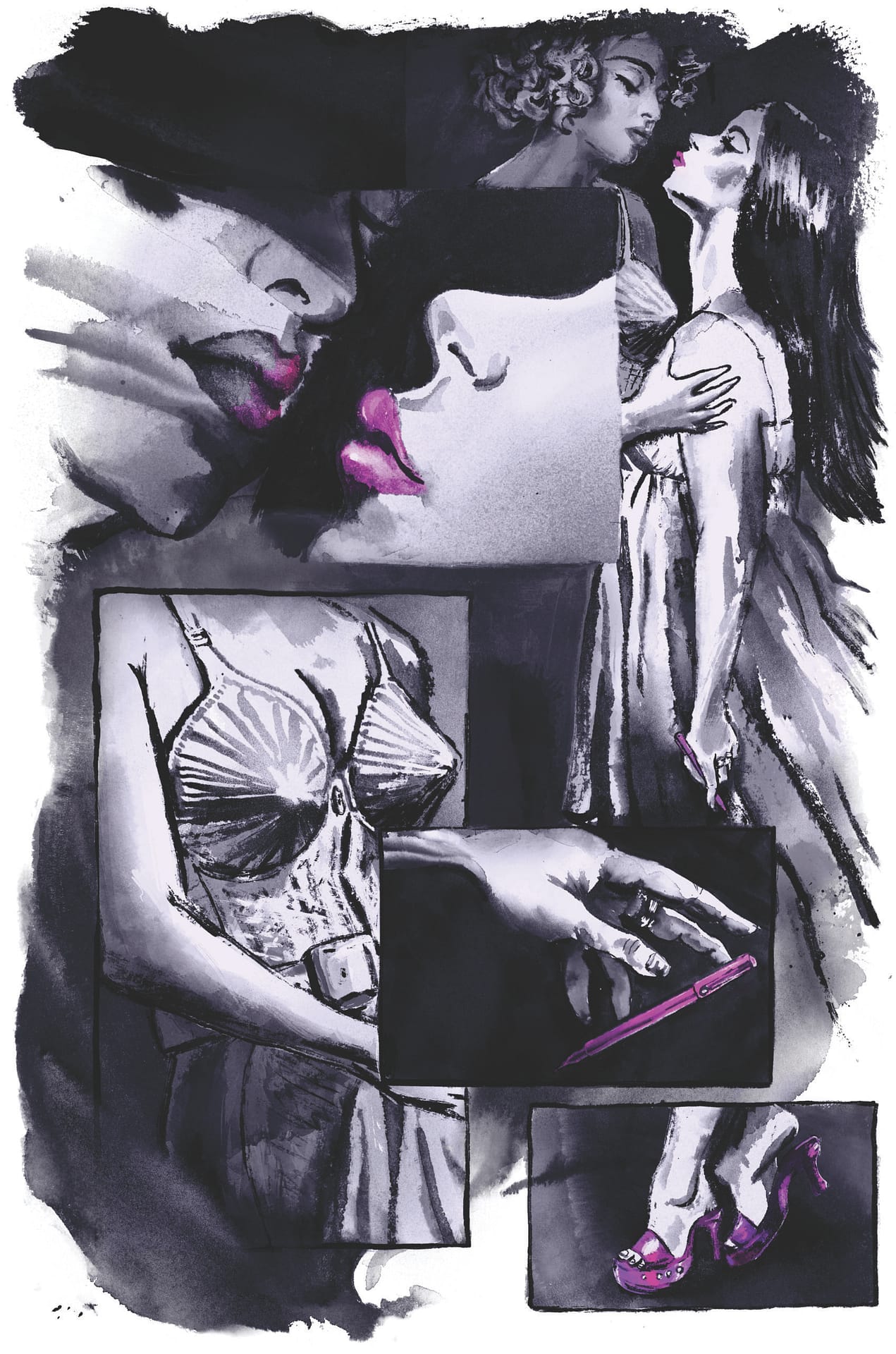
I stood proudly before Brendan in a pink Marrika Nakk flowery baby doll dress with stripes of sheer white lace cutting through it and high heeled vinyl patchwork wooden sandals, topped off with bright red lipstick.
“Uh…” he said.
“This isn’t right is it?” It was the only thing I had brought.
“Uh.” We stood looking at me in the mirror. I was 26 and I’d never looked so ridiculous in my life.
“What do I look like?” I asked.
“I’m not sure,” he said. “It’s sort of crazy and sort of sexy. And like a clown. A crazy sex-clown.”
When I arrived, I was greeted by Caresse Norman, Madonna’s assistant, who later became her manager and one of the film’s producers.
She gave me a Diet Coke in a cobalt goblet and ushered me into Madonna’s inner office which looked like a living room.
And there was Madonna. She was nine months pregnant with Lourdes, wearing a long black dress with a tiny knit cardigan and several pounds of gold chains with crosses and saints around her neck. She held a huge plastic jar of candy “spice drops” on her stomach and put a handful of them in her mouth. She didn’t look like Madonna, more like a big pregnant woman. I’d known she was pregnant but I hadn’t expected her to look pregnant. I guess I’d just expected her to get around it.
She stood up and took a few steps toward me, waddling slightly on the most incredible high heels I had ever seen, dozens of black straps positioned perfectly around her toes and ankles. “Don’t worry,” she said. “We’re not going to turn your book into the next Pretty Woman.”
“I wouldn’t mind if you did,” I said, finishing my Diet Coke.
“You liked that movie?” Madonna said with disdain.
“Yes,” I said. “And I wouldn’t mind my book winning an Oscar and making billions of dollars.”
Madonna glared at me. “Why don’t you have another glass of red wine and think about that,” she said. I was horrified. In the blue goblet, my Diet Coke looked exactly like Merlot. She thought I’d been sitting there chugging wine. I had to somehow start again.
“You’re nine months pregnant and you’re thinner than I am,” I said. She nodded in agreement. She seemed pleased. “Thank you,” she said. “As you know, I’m a big fan of yours. And we’ll definitely get the movie done. I’m known for getting things done.” It was sort of touching to see Madonna explaining herself like that.
I told her that I had heard that about her.
“It’s going to be my directorial debut,” she said.
I coughed. “What?”
“Didn’t I tell you I was going to direct it? And you’re going to write the screenplay.”
That was huge. If Madonna directed it, it would certainly get made. And people would want to see it.
“So do we have a deal?” she asked.
I told her I had to consider other offers and she looked surprised. Then, as I was leaving, I said the stupidest thing I’d ever said in my life. “Let me know if you know any men you think I should meet.”
It was as if I were visiting the Pope or the Dalai Lama and I thought that if she set me up with someone it would be a holy union. My husband and I could forever tell people that we had been introduced by Madonna.
She looked at me like I was insane. “You want me to set you up with someone?” she asked slowly. I had just meant to attempt friendly girl talk. I hadn’t meant for it to sound like part of the deal, like she was a pimp. The words played themselves over and over in my mind. Why had I done that? I was meeting with Madonna to discuss her turning my book into her directorial debut. What on earth did men have to do with it?
“Why does everyone ask me to fix them up?” Madonna said.
I called my agent and told her I wanted to accept Madonna’s offer. The other producer, Linda Obst, had tempted me by saying that she and I would have what she called “a big meeting.” A big meeting was seven days at Canyon Ranch discussing the script between body scrubs and massages. Obst was the brilliant producer of Sleepless in Seattle, The Fisher King, and many other great movies. Madonna had produced nothing. No one thought I should go with Madonna. But every time I thought about not going with Madonna I got a disappointed feeling in my stomach.
Madonna called me. “I’m surprised by your decision,” she said.
“Why!” I asked.
“I thought you had decided against me,” she said. “We’ll start the paperwork.”
I didn’t need the plane to fly me home to New York. I was floating above it the whole time. Madonna had optioned my book. I was going to write the script and have regular meetings with her. I was going to be paid a lot of money. That morning I’d had breakfast with my great uncle Don Kranze who had been the assistant director of The Graduate and Twelve Angry Men. He convinced me to take the screenwriting job even though I’d never done it before and didn’t really think I could. “Take the job, kid,” he said. “What do you have to lose? Even if you write blah blah blah they still have to pay you.” I had never been happier than on that plane but for some reason I couldn’t stop crying.
When I got home I opened the door to my apartment, a fourth-floor walk-up railroad flat on MacDougal Street, and there on my kitchen floor was a mass of cockroaches crawling all over something. It was a dead mouse. Roaches having a feeding frenzy on a dead mouse. The smell was overwhelming. How glamorous could my life get?
10/8/96 I had a great talk with Madonna. She told me to see a movie called Bound. She said it was awful but very well directed. She said it’s a coincidence that Bennington worked as a coat check girl at the Russian Tea Room because she did too for three months. Saw Warren Beatty come in with different girls. Got fired for wearing fishnet stockings. Liked a girl there named Francois. Madonna said the words “Good Grief” a couple of times! It’s so nerdy. So Charlie Brown. Good grief. I tried saying it but I couldn’t pull it off. She said things like, “Bennington desperately needs to be comforted in this scene.” I love her.
The next day I went to my office to announce that I was taking a leave of absence for three months to write the screenplay. I was a real estate agent working at the Corcoran Group’s downtown office. I brought a cardboard box and carefully started packing my files to take home.
A broker named Glenn Schiller (who we called Glenn Gary Glenn Schiller) stopped me. “What are you doing?” he said. He was a friend of mine, a typical aggressive successful New York City real estate agent, probably the only straight male one in the city.
“I’m packing,” I said.
“You don’t need this shit,” he said. He grabbed a big black garbage bag and started throwing everything into it: the cardboard box with the files in it, the clever real estate-related New Yorker cartoons on my bulletin board, my stapler, Filofax.
“Get out of here,” he shouted. “You’re a successful writer now. You don’t need this dump anymore. You’re never coming back. I’ll kill you if you ever come back here.”
I tried to protest but he screamed “Get out,” and rolled me out the door in my desk chair. I felt like Debra Winger being carried out of the factory in Richard Gere’s arms at the end of An Officer and a Gentleman. It was a perfect Hollywood ending. Glenn Schiller was my Richard Gere. And I didn’t care what Madonna thought about Richard Gere movies. I liked them.
I had no idea that I was making the biggest mistake of my life. I didn’t know that the real estate market in New York was about to boom and that the pathetic wayward agent to whom I’d lent twenty dollars on my way out the door would, in a matter of weeks, be making more per quarter than you could make in three movie deals.
I checked my messages from a payphone. I had five. Three from Madonna saying she wanted me to meet with her publicist, Liz Rosenberg; she wanted me to come to her apartment in New York next week to outline the script; and she wanted me to see the movie Palookaville because she really loved it and wanted to know what I thought about it. The other two were from the phone company and ConEd shutting off my phone and power, respectively. So with no job, no phone, and no electricity, I went straight to the Angelika movie theater and saw Palookaville. Even though Madonna wasn’t actually with me I felt like she was. I discussed the movie with my new best friend in my mind the whole time.
10/14/96 I’m at Dad’s country house. He is so excited about my deal that he actually rented Truth or Dare and we are sitting on his couch watching it. This is very strange.
Before I started working on the script, at Madonna’s request I met with Jane Rosenthal, the head of Tribeca Productions, Robert De Niro’s company. They were in discussions to co-produce. We met in her office, which was adjacent to De Niro’s office, under an enormous skylight. I passed through his office on the way to his private bathroom which had a bidet and giant hot tub, with white terry cloth robes on hangers. For the hell of it I sat at his desk for a minute and picked up a first edition of Moby Dick.
Just as Jane and I started talking, her phone rang. It was Madonna. “Well when do you want to start shooting?” Jane asked. “January? But it’s October and we don’t have a first draft of a script yet. There’s no way you could get a polished script in time, let alone cast it.”
From what I could tell Madonna seemed to be holding firm to January.
“We can start in January,” Jane said. “NEXT January. Not this one. And even that’s optimistic. Okay. Thank you.” She got off the phone and looked at me. “I don’t think Madonna’s too happy with me,” she said. We sat in silence. “I think the meeting’s over now,” she said.
The contract negotiations dragged on and on and in the meantime I began writing the screenplay.
10/29/96 How can I do this? How can I write a great movie in three months? My head is splitting open with images and words. There is a movie screen inside of me and an auditorium with people and seats. How did I become a film writer? This is so crazy.
11/6/96 I just faxed Madonna the revised pages from last night’s conversation. She had very few comments. That was last night midnight and she called again this morning at nine her time and said, “Hi it’s Madonna, I’m just calling to annoy you. I was wondering if you could fax me the revisions.” Luckily I had done them because I couldn’t sleep after talking to her. I can’t believe she said, “I’m just calling to annoy you.”
Madonna called me with a complaint. She didn’t know why she had to fax things to me at Abe’s copy shop on MacDougal Street. “I don’t want some guy named Abe reading all our stuff,” she said.
I told her I didn’t have any money and I couldn’t buy a fax machine. “But I paid you a lot of money,” she said. I reminded her that I hadn’t actually received any of it. She was shocked to hear that I hadn’t been paid and rushed me an advance of twenty five thousand. “But you have to promise to buy a fax machine.” The issue of the fax machine came up a second time. One moment I was surprised by her generosity and the next I was surprised by her cheapness. “You’re using up all my fax paper,” she said. “I can’t keep replacing it. I want you to FedEx pages to me.” (At my own expense.) It was hard to imagine Madonna worrying about things like fax paper.
12/1/96 Madonna called me Friday to say that she couldn’t really talk but that she hadn’t forgotten me. She was whispering. “Why are we whispering?” I whispered back. “Because I’m nursing my daughter and she’s falling asleep,” Madonna said. She had an idea for an opening—wants a big scene. I asked her what her overall feeling about the fifty-seven pages was and she said they were brilliant and hysterical. She said she’d call me back and we’d go over everything in detail. She was so nice and friendly and the baby was making little noises in the background and it seemed like money and lawyers and contracts were a million miles away. I got excited. She likes it. She said yes, I can start using inner thoughts in voiceover as long as it’s not narrative.
12/7/96 A girl just came up to me and asked if I wrote Going Down. Her name was Poppy Fields. She handed me an 8×10 and asked if she could play Bennington. I put it in the huge file of headshots I’ve received to give to Madonna.
Christmas came and I went to my mother’s loft in Tribeca. My mother handed me my present. A tiny wrapped box. I prayed it was a hundred dollar bill. The money Madonna had sent me (minus 15% for my agents) had gone to pay bills. There were so many things I needed. I didn’t have a good winter coat. There were holes in my boots. I had my book tour in London coming up and a meeting with Madonna back in New York. I opened the present, praying it was money for boots. It was a tiny Limoges pill box in the shape of a book with the words “my diary” painted on it. It was from one of those stores near the Plaza on 59th Street where they sell alabaster eggs. I looked down at it in disbelief. And then I just started crying like a little girl.
“You don’t like it?” my mother asked. “I thought you could use it when you meet with Madonna, if you have to take a pill or a vitamin,” my mother said.
On my book tour in London I went on a TV morning show called The Big Breakfast. They ushered me onto a set where there was nothing but a giant bed covered with plush animal print pillows. They informed me that the interview would take place in bed with the host. I climbed up on it and a large woman got on next to me. I propped myself up on the pillows with my legs stretched out in front of me. I had no idea that the camera was at the foot of the bed, so while I answered question after question about Madonna the giant holes on the bottoms of my boots were plainly featured.
But the worst part of the trip was an article about me in The Guardian. The article was entitled “Madonna’s New Best Friend” and there was a photo of the two of us appearing to be arm in arm, even though we’d never done more than shake hands. They’d spliced two photos together in a hellish collage, but I was bigger than she was and wearing a boxy suit jacket, and she was radiant in an evening gown. In big letters they’d pulled a quote: “‘I was sure she would be a bitch,’ Jennifer Belle said.”
1/14/97 I met with Madonna today in her apartment at 1 West 64th Street. M was thin and much more beautiful than the first time, wearing a slim, antique-looking beige and black lace skirt, hair in a ponytail. She looked tiny and delicate. And happy. Lourdes had huge pearl earrings on her tiny red swollen ears. There was a stack of photos of Rosie O’Donnell holding the baby.
Before I went to Madonna’s apartment I put on my best underwear. My sexiest bra and matching panties. Why are you doing this? I asked myself. I didn’t really expect her to see them, but I wanted to be prepared just in case. I didn’t know what a meeting in Madonna’s apartment would be like.
Her new assistant told me to wait in the living room. I used the bathroom where a little sign hanging on the wall said, “Do Not Deny Your Homosexuality.” In another room I could hear the Oprah show on. Lourdes was in there with the nanny.
The living room had a satiny midnight blue couch. There was a coffee table with a bowl of very old looking pistachio nuts. I could understand why they were old—who in their right mind would sit on Madonna’s couch and start shucking pistachio nuts?
The walls were lavender and covered in paintings, one by Leger, one by Dalí, and two by de Lempicka—a naked woman with a dove, and a naked woman in shackles. A framed photograph entitled “M with Child” was of Madonna in a men’s white undershirt holding newborn Lourdes high over her head. The photo was filled with triumph, pride, love, glamour, pain, and ecstasy. It reminded me of the photo of Marilyn Monroe lying on a bench lifting weights, but instead of weights it is a tiny baby in Madonna’s muscled arms. There was a piano, and two things that struck me as strange—several bulbs in the ceiling’s recessed lighting were burnt out, and there were Duraflame logs in the fireplace. That was something I expected to see in my own apartment.
A green awning covered a small balcony facing Central Park at tree level.
Finally Madonna came down the stairs and apologized that her prior meeting had taken longer than she’d thought it would. I heard the assistant saying goodbye to someone, I think it was director Sam Mendes.
I gave her a book of saints that my editor had insisted I give her. “You probably don’t want this,” I said.
“Why wouldn’t I want it?” she asked, looking hurt. I couldn’t say anything right.
“I’m tired,” I said. “I just got a puppy. Do you have a dog?” Why did I have to sound like a little girl trying to make friends in a playground?
“No,” she said, sadly. Then after a moment, “Wait, what am I saying, I have three dogs.”
She led me through the kitchen, with a table wedged between two banquettes like at a diner. Giant jars of candy lined the counters—Twizzlers, Redhots. There were several bouquets of flowers, still cellophaned and ribboned. Madonna paused for a moment and looked at one of them. “I wonder who these are from?” she said. She glanced at the card. “Oh, him.” Then she looked at me. “I don’t know why I just said I didn’t have a dog. Weird.”
I followed her up a very steep staircase and into a more casual living room with an art deco bar and two big brown leather chairs with ottomans. Again, the room was very dark. There were framed signed photos of Mohammed Ali on the walls.
She sat in one of the chairs and laid the manuscript pages out on the ottoman. The other chair was too far away from her so I sat on her ottoman next to the pages. She had written copious notes. Something was circled in red.
“This line here isn’t right,” Madonna said. “When Bennington calls her stepmother a fat whale. She should call her a fat cow.”
“But there’s a lot of whale imagery throughout the script,” I said.
“That’s all well and good, but nobody would call someone a fat whale. They’d say fat cow.” She said “fat whale” and “fat cow” a few times to demonstrate her point. “And one more thing,” Madonna said, looking through the pages. “I liked the scene where Bennington and Perry are practicing a scene from Shakespeare in Washington Square Park. Where did that go?”
“I don’t think that’s a good scene,” I said.
“It’s great!” she said. “I’m going to dress them in Shakespearean costumes.”
It was a strange argument to have—I was trying to get rid of what I had written and she was fighting for it to stay. The scene went back in. Whale was changed to cow. Many times during the three months that we worked together she’d make a suggestion and I’d think it was wrong. Days later I’d sit up in bed and realize why she’d been right. She was instinctual but not analytical. It was as if she had millions of microscopic tentacles all over her body. She could feel what worked, and let other people come up with reasons. I had never met a more intuitive person.
I handed her the dozens of letters with professional headshots and amateurish Polaroids I’d gotten from girls hoping to play Bennington. Madonna read a few of them out loud and examined all the pictures. “This one looks good,” she said, about a sort of chubby girl. “Maybe I’ll call her.”
“So when can you get me the rest of the pages,” she asked.
I was just thinking that when I left there I’d have lunch and take the rest of the week off.
“Can you get them to me by four o’clock?”
“Today?” I asked, shocked. It was at least two weeks’ worth of work.
“I’m flying to London and I’d love to get them by four so I can read them on the plane.”
I don’t think she meant to be unrealistic, or overdemanding. She worked so hard herself, she expected others would do the same. When I explained that it would be impossible, she accepted it graciously and we “compromised” on the day after next.
I didn’t use the Limoges pillbox once during the whole meeting.
Finally the contract came and I had to sign a “Certificate of Authorship” stating that Madonna was the author of Going Down. The whole contract was terrible. I hadn’t retained my own lawyer. “I’ll sign it,” I told the agent. “But tell Madonna I want her to kiss me because I like to be kissed while I’m getting fucked.”
Flowers came on my birthday, a giant bowl of roses and tulips in the exact same shade of pink. “Happy Birthday Love, M” the card read. I had no idea who they were from. My brother Matthew? I called the flower store. Ohhhhh. M.
2/25/97 Madonna called me this morning and said she read my finished script. “And?” I asked. “And I think it’s remarkable and commendable,” she said. But then she sort of implied that she had been worried. That it didn’t look like it would come together the last time we’d met. My heart sank. Madonna had been worried. Not seeming worried was another incredible kindness on her part. An Oscar-quality performance. Another testament to her professionalism and the respect she gave the people she collaborated with.
2/27/97 Madonna called me from her car phone and said she “cast” Gena Rowlands in the role of Holly and Isabella Rossellini as Gail. I don’t know if that means she actually spoke to these people. I wonder if there is a part for Penny Arcade.
I met with Madonna in her apartment again and laid out pages of the script on the floor at her feet. We were discussing what final changes she wanted me to make. And for some reason I was the one telling her what to do. “Okay,” I said, “you read pages 47 through 70 and call me tomorrow and we’ll…” I looked up and saw her gorgeous glowing face concentrating on what I was saying. “I can’t believe you’re Madonna,” I blurted out. And the spell was broken. She looked angry. It was insensitive of me. Everything had been going so well and then I had to act like an idiot. Just as I thought the meeting was going to end on this terrible note the nanny came running in and said that Lourdes had just turned over in her crib for the first time.
Madonna and I jumped up and followed the nanny into the nursery, which was all done in matching floral upholstery. The nanny put Lourdes on a blanket on the floor. The baby was beautiful. She looked different from other babies. I didn’t know how a baby could look richer than other babies but she did.
After we waited a while in vain for Lourdes to turn over again, Madonna scooped her up and walked me to the door holding her. “I’m going to feed my daughter now,” Madonna said with a voice filled with pride. She always referred to Lourdes as “my daughter.” She turned and walked away down the corridor and it was one of the most amazing and beautiful sights I have ever seen.
I never got to see Madonna again.
9/15/97 This morning I got a call that there was good news and bad news. The good news is my book is in its ninth printing, the bad news is Madonna has hired someone else to re-write my script. Everyone seemed scared to tell me as if they were afraid I was really going to fall apart. Everyone said it was always a mistake to get involved in adapting your own book. “Well I disagree with that,” I said. I’m glad I did it.
What if Cinderella had to write a piece about the whole ball/glass slipper thing after the prince divorced her? I don’t think she would be angry at her fairy godmother.
Madonna started to lose interest in the project. After she had Lourdes she decided she would only produce Going Down, she wouldn’t direct it. It was my private theory that she had thought she might need a year behind the camera after she gave birth but looked so incredible so fast that she thought she might as well stay in front of the camera for another decade. She has all the time in the world to direct. And it just took too long. Jane Rosenthal, it turned out, had been right.
5/3/98 L.A. I met with Gary Ventimiglia, the new head of MadGuy at about six in the morning. It was a terrible thing they do in L.A. called a “breakfast meeting.” He ate something called “egg white steamers.” He said Madonna was “definitely” going to make my movie. I said, “Do you have a production schedule yet?” He said, “We will when we set one.” Anyway, although Los Angeles has a way of draining the excitement out of things, I think Madonna is going to make this movie.
8/6/98 Well my movie is being made. And I have to say I feel like a genius for going with Madonna. Of course I would have felt the opposite if it hadn’t happened.
The last time I spoke to Madonna on the phone she asked me if I had a boyfriend. “I’m dating someone but I’m pretty sure he’s gay,” I said.
“Does he have any Judy Garland CDs?” she asked.
“He has The Wizard of Oz on video.”
“He’s gay,” she said.
And that was that. A two year professional relationship, a life-altering opportunity ending in a few seconds of girl talk. And wasn’t that all I had wanted in the first place?
10/22/98 I’m in Rome. I got a call that Madonna wants me to “compromise” on the contract and accept less than the $350,000 up-front money in exchange for more points on the back end. I asked, How much of a “compromise”? $350,000 worth of compromise. She wants me to take ZERO. Millennium, the new producers, are only willing to throw a few million at it. They can only go ahead and make the film if I do it for free. Madonna’s new video just came on the hotel television. She has black hair and is playing chess for some reason. She is all over Rome.
When the paperback to the German edition of Going Down arrived, against my will it was renamed Hilfe Ich Falle, or “Help I’m Falling,” and renamed again by my friends, “Help, I’ve Fallen and I Can’t Get Up.” If that wasn’t bad enough, there on the front cover is a “blurb” from Madonna. “Don’t go for second best, baby.” –Madonna. They were so desperate to connect me to Madonna they stuck a random song lyric on the cover.
12/15/98 On Friday I got news that Madonna had agreed to pay me the entire $350,000 and guarantee me shared screen credit. I couldn’t believe it. It was more than I was asking for. I got flushed with heat. I called my parents, my brother, and my friends, then the call came that Madonna had changed her mind while she was making out the check for $350,000. She wrote it for $25,000 instead to renew the option for another year. I had to call everyone back.
8/31/99 Bad news today—Madonna is definitely not going to be in the movie and we’re at a stand-still. It doesn’t look good.
9/1/99 Today I called a psychic priest to ask if Madonna was going to make my movie and he said he could see Madonna turned away from me with her arms crossed. “What about a boyfriend?” I asked him. He said if the right man fell out of the sky and landed on top of me I’d throw him down the stairs. I was shocked because I was sitting at the top of my steps when he said it. He said my second book would be successful. His actual words were “would have some goodies attached.”
On the day I moved into my new apartment, Gary Ventimiglia called and said he was in New York and could he come over with a bottle of wine. He said that the only way Going Down would be made was if I agreed to receive $100,000 less than we had initially agreed to. The only thing blocking the green light was me. I was standing in the way of my own movie being made. Madonna couldn’t afford to pay me the full amount. I pointed out that I couldn’t afford my apartment but I had taken it anyway. “If you lower your price I promise Madonna will make your movie,” he said. “And we’ll make you a producer.” I told him I couldn’t afford to be a producer.
I was told that Madonna had said, “Jennifer Belle has to learn the meaning of the word ‘compromise.’”
I said, “Tell Madonna she has to learn the meaning of the word ‘contract.’”
In the end I did agree to go down $100,000, but it didn’t help.
11/24/99 Yesterday I called Chris Hanley from Muse Films myself and just said, “Do you still want to buy Going Down?” and he said, “Yeah, why not, I think it’s great.” He’s going to be in Africa the week Madonna’s option expires but he’s going to arrange to negotiate by e-mail. I told CAA to tell Madonna no to an option renewal. It is very risky because Chris could flake out over there in Africa and change his mind and I would be left with nothing. But he’s been interested since 1996.
Madonna and I never said goodbye. She said she wanted to renew the option for three months and I was so sure by that point that she wasn’t going to make the movie that I said no and sold it to Chris Hanley at Muse Films (Buffalo 66, Virgin Suicides, American Psycho). They couldn’t use my screenplay because Madonna owned it. Even though she no longer owned the rights to the book she still owned the screenplay because it was a work-for-hire. She couldn’t, however, do anything with it. Muse could buy it from her but it would be much cheaper for them to hire someone to write a whole new script.
I never heard from Madonna again. I read in Variety that she was being sued for two million dollars by Millennium, the producers she brought in to work on Going Down at the end because they claimed she had pulled out so arbitrarily. She was going to play the tiny part of “Brandy” and decided not to at the last minute, refusing to give a reason. And when she did that, the actors who were about to sign on, withdrew. If the pilot doesn’t even want to get on the plane the passengers aren’t so quick to line up at the boarding gate.
I never properly thanked her, in fact I never thanked her at all. I didn’t know how to. A few months later I ran into Gary Ventimiglia in the Gucci store in L.A. I was with my friend Brendan who was returning something so I was just pathetically standing in the middle of the store, not shopping or even letting myself look. Gary walked right up to me.
“I heard about your new book,” he said. “But you probably don’t want to send it to us. You probably hate Madonna.”
“I don’t hate Madonna,” I said. “She probably hates me.”
“She doesn’t hate you,” he said.
“Well I don’t hate her.”
“Good,” he said. “So nobody hates anybody.”
And once again I was high. As high as I was during that first phone call when she said, “I love your book.”
A big biography of Madonna came out and I stood in the bookstore looking for my name in the index. There it was. I turned frantically to the page. “Writer, Jennifer Belle, was plucked from obscurity…”
Plucked, only to be put back there, I thought. Back to being just a fan.
“Your ring is extraordinary,” Madonna had once said. I was wearing my great-grandmother’s heart-shaped aquamarine. I’d had an incredible urge to pull it off my finger and hand it to her. It seemed like the obvious thing to do. Somehow I’d stopped myself. At least I still had my ring. It probably would have ended up tossed in a junk drawer.
My only regret is not saving her messages on my answering machine.
Jennifer Belle is the author of six novels, including Going Down, High Maintenance and—most recently—Swanna in Love.