
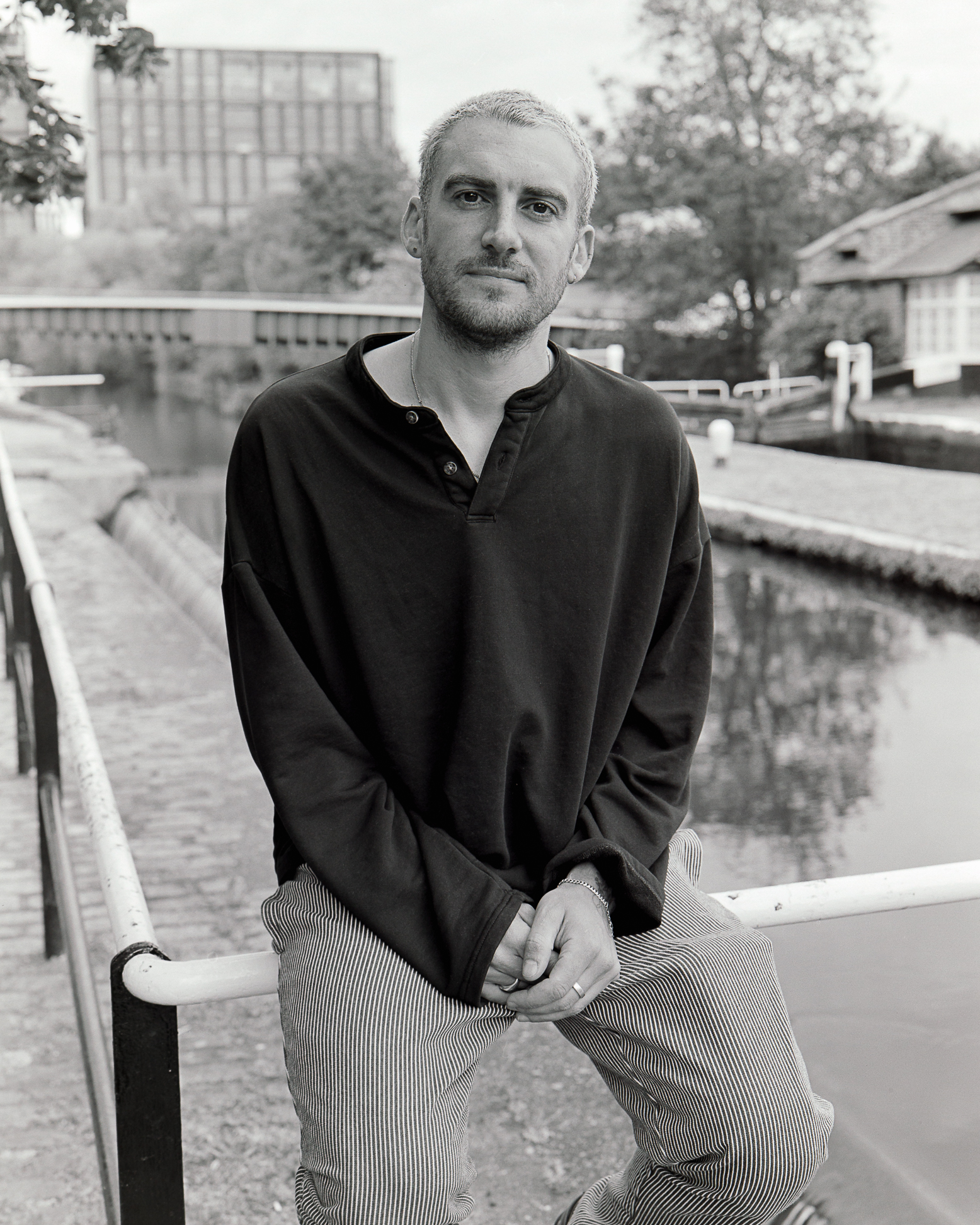
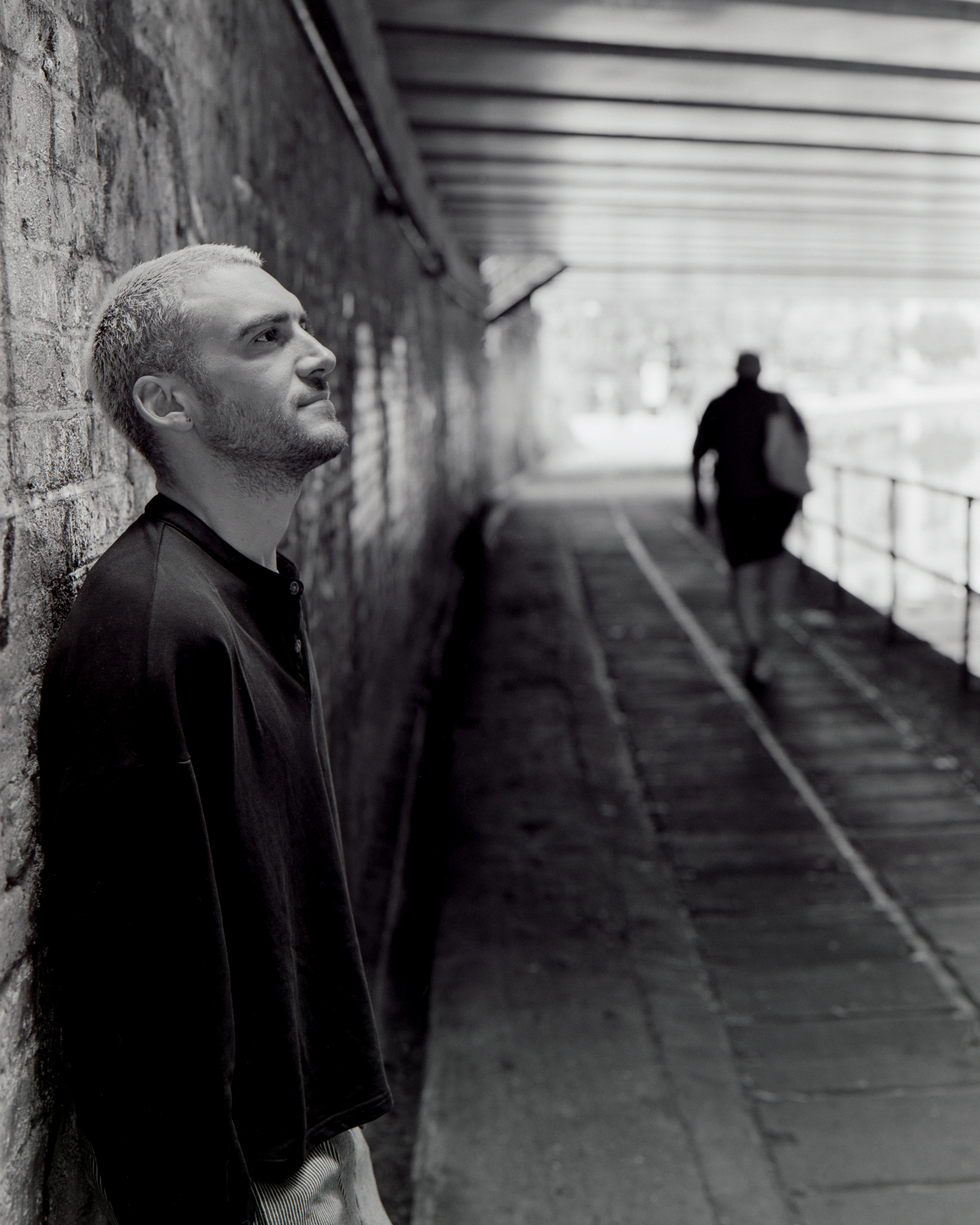
A few days after the publication of Fruit Fly, Josh Silver was already confronting a dilemma most novelists would gladly endure: you couldn’t buy his book. Caught unprepared for the early surge of interest, his British publisher rushed a reprint. At Libreria, the East London bookshop I manage, we scrounged copies from neighbouring stores to meet demand for a launch event, but many of those stores had run dry too.
Not long ago such a scenario would have been implausible enough to resemble the plot of a speculative novel, perhaps one by Josh Silver himself: snatching what little time he could from his nursing job, often in his parked car during lunch breaks, a young novelist writes a razor sharp satire on cultural appropriation in the publishing world and is rewarded with an near-immediate bestseller.
Fruit Fly is partly about the dangerous seduction of external validation. Silver is now receiving it in spades. The whole experience has been “a bit meta,” he admits. “It did get a bit confusing at times when I was writing it—being a gay, sober addict writing from the point of view of a woman who was writing the story of a gay addict who’s on Grindr.”
Fruit Fly is a great read, with a sly double-ending, and its neon green cover certainly makes a splash in a bookstore. But it’s hardly the first gay novel with a twisty plot or an eye-catching cover. What made this one such a breakout? Although it made the paper’s vaunted bestseller list, Fruit Fly was not reviewed by The New York Times, and was largely ignored by critics. Its success seems to have relied entirely on word-of-mouth, and Silver’s energetic Instagram game. A few months after it was published Silver sold the TV rights to indie studio darling A24 Films.
Silver’s ascent has been rapid. After signing our diminutive pile of books at the Libreria event in May, he had dashed off to catch a train to Manchester to interview for a nursing job early the next morning. That night he was back in London for another event in Peckham with the Booker-longlisted author Djamel White, which I also moderated. Silver began by reading out the rejection email he’d just received. “I just found out just two seconds ago that I didn’t get the nursing job,” he said to a chorus of awwws, before adding, “So, yeah, the universe is telling me something.”
The universe was telling him something, but although he seemed as blindsided by his subsequent success as anyone, it didn’t emerge out of a vacuum. Silver had the good fortune to publish into a culture that had been primed for him, a phenomenon that Fruit Fly nails. Over the past few years, writers such as Torrey Peters, Douglas Stuart, Ocean Vuong, Bryan Washington and Yael van der Wouden have dismantled the old assumption that queerness narrows a book’s potential audience. Peters’s Detransition, Baby, a funny, sexually frank novel of trans life, sold over 100,000 copies; her follow-up, Stag Dance, was a Pulitzer finalist. Shuggie Bain, rejected by 32 American publishers, won the Booker Prize. Stuart’s latest, John of John, is on the Booker shortlist, alongside The Disappearers by Marlon James.
The books are wildly different from one another, which is partly the point: queerness has ceased to function as a genre in itself.
The author and publisher Rakesh Satyal puts the shift more provocatively. Talking to a publishing friend about the same-sex ice hockey romance Heated Rivalry, he realized that they were treating the show’s queerness as incidental to its success. “They weren’t acknowledging that the queerness was one of the reasons why it was really working,” he says, “that it wasn’t just by happenstance or that it was incidental to it, but that in fact it was woven into its success.” Likewise, Silver is not simply a beneficiary of better marketing or his picturesque Instagram feed. He is in the right place at the right time: writing for a readership that the publishing industry spent decades failing to imagine.
In his short story “Career Move,” Martin Amis invented a parallel world in which poets are rich celebrities commanding vast advances while screenwriters toil in obscurity, grateful if anyone reads them at all. The joke works because Amis merely reverses an order that seems immutable. Something similar has happened to queer fiction.
Edmund White recalled being harangued in 1973 by the critic Richard Poirier, himself gay, for entertaining the idea that there might be such a thing as gay fiction, much less a “gay sensibility.” Gore Vidal described gay literature as a “vast cemetery… where unalike writers are thrown together in a lot, well off the beaten track of family values.”
For much of the 20th century, to be labelled a gay writer was to be directed towards the margins, admired in a few cases, but also downsized. Edmund White recalled being harangued in 1973 by the critic Richard Poirier, himself gay, for entertaining the idea that there might be such a thing as gay fiction, much less a “gay sensibility.” Gore Vidal described gay literature as a “vast cemetery… where unalike writers are thrown together in a lot, well off the beaten track of family values.”
The writers who came later pushed against that enclosure, but AIDS interrupted the flowering with horrifying brutality. It killed writers, obviously, but also readers, critics and booksellers. For years afterwards, the designation “gay writer” remained a poisoned pink chalice.
No longer. You only need to look at the numbers to see that something has shifted. In the United States, BookScan recorded roughly $8 million in annual sales of LGBTQ fiction in 2015. By 2025 the figure was $82 million, at a time when sales of literary fiction more broadly declined. What was once considered a niche that could limit the reach of a novel, now looks like the very opposite.
As Mallory Maddox, the protagonist of Fruit Fly, discovers, gay fiction sells. Maddox is a former literary wunderkind who has hit the skids, devoid of new ideas, and stuck with a controlling and manipulative husband. Drunk and desperate, she Googles how to write a bestseller. Fantasy is hot. Crime is reliable. Or she can “go gay, go sad, go dark.”
Mallory goes for the latter option, downloads Grindr for research, and soon encounters Leo, a 22-year-old gay addict while parked in a car outside a chemsex party. Leo, she quickly decides, is her protagonist. His sexuality, addiction and suffering are not impediments to commercial success. They are the point. The relationship between the two, needy in both directions, is what fuels Silver’s novel.
Fruit Fly is satire, and it works because the calculation is no longer ridiculous.
When I was younger and struggling, I would really be desperate for people to notice and see me, and validate me. I realized that pain had currency, and the more I could talk about my pain to people, the more pints they would buy me, or the more they would seem interested in me or want to come and save me.
Josh Silver
“Leo performs his pain to Mallory, and elaborates it,” says Silver. “It reminds me of when I was younger and struggling, and I would really be desperate for people to notice and see me, and validate me. I realized that pain had currency, and the more I could talk about my pain to people, the more pints they would buy me, or the more they would seem interested in me or want to come and save me.”
The irony, for Silver, lies in Mallory’s assumption that she’s writing an authentic story because it belongs to someone else. “But Leo’s lying massively about his experience, playing up to the stereotypes of this dark, struggling addict.”
The real transgression is not that Mallory writes a queer narrative. It is that she cannot permit her protagonist any complexity or contradiction on the page. His usefulness depends on remaining a type.
Since it was published in late April, I’ve lost count of how many times I’ve seen Fruit Fly referred to as “the buzziest book of the year.” At the bookstore where I work, it has been a bestseller all summer, with women among its most avid readers. A novel about a young gay addict, Grindr and chemsex, written by a gay man and saturated in the language of queer life, evidently does not require a gay male reader. And why should it?
Publishing spent decades behaving as though identity moved in straight lines: gay writers wrote gay books for gay readers; women’s fiction was for women; Black novels had Black audiences. Actual readers have always been more freewheeling than that. For gay readers of a certain age, it wasn’t remotely possible to be otherwise. Being in the closet trains you to be an allegorist. In the absence of gay narratives, young queer readers gravitated to science fiction or horror, genres rooted in estrangement and altered states. As a teenager I projected my desire through the female protagonists of heterosexual romances featuring sinewy Jewish men by Lynne Reid Banks. I was an adult before I found my way to gay novels by Edmund White and David Leavitt.
Leavitt’s The Lost Language of the Cranes, in which a son and his father come out almost simultaneously, was a revelation. For the first time I could read about men desiring men, without needing the imaginative sleight of hand I had to use with Lynne Reid Banks. The title comes from the case study of a neglected child who, left with only construction cranes visible from his window, begins to imitate their movements. Leavitt built around that image a novel about gay men inventing languages in the absence of models. Revisiting it much later, I was pulled short by a sentence I could not have understood properly the first time: “The window becomes a mirror; whatever it is that we love, that is who we are.”
For queer readers of my generation, the mirror was difficult to find. Today it is impossible to avoid. We see our reflection everywhere.
A teenager can move from Heartstopper to Ocean Vuong, from Rachel Reid to Douglas Stuart, from trans horror to queer historical fiction. The coming-out narrative has not disappeared, but it has lost its obligation to explain an entire population.
Satyal, best known for his Lambda Literary Award-winning debut novel Blue Boy, offers a useful analogy for the change. Learning a language, he says, begins with articles and basic conjugations. Eventually you become fluent enough to say more complicated things. Queer literature has reached that stage of fluency.
Silver had been thinking about Yellowface and American Fiction, stories about minority experience becoming commercial raw material, and realized nobody had written the gay version. A former actor, he had experience of how things had flipped in a relatively short amount of time. After graduating from drama school, he was advised not to seem gay as it would limit his roles. “Several years later, there was this whole push for diversity, and it was like, ‘Go forth and be gay.’ Like, ‘Go into that casting room with a feather boa and tell them you are gay,’ because they are only casting gay parts. It had currency all of a sudden. I was offended by it.”
Silver grew up watching straight actors win prizes for playing gay men while gay actors were encouraged to remain closeted. He is not interested in prohibiting anyone from playing anyone else. What troubles him is the historical asymmetry: shame could be borrowed for the duration of a performance and rewarded, while those who actually lived with it were often expected to keep quiet.
The shift that Silver saw on stage and screen is now occurring on the page. As a writer of several YA novels, Silver has witnessed how the thing that could once damage your prospects is now the thing other people wish to borrow. “In YA queer is really popular,” he says. “All of a sudden people were like, ‘Throw in a non-binary character… Make sure there’s a gay character.’ Of course I want there to be representation of people in books, but who is saying you need that? Ultimately a lot of it is to do with money, selling books, selling stories, getting eyes on it. Who’s telling the story and, and whose lens are you viewing it through? I don’t know, but I am interested in why those choices are made and why there’s an appetite for it.”
I’d gone from spending years and years and years obsessed with myself, to being forced to think about the present moment, among people from all walks of life. I’d gone from a world where it was important for me to say two lines in a BBC drama to seeing real life in front of me—people struggling in huge and horrendous ways. It was a reality snap for me.
Josh Silver
And yet Fruit Fly is far too intelligent to argue that queer stories belong exclusively to queer writers. Silver himself writes half the novel from a straight woman’s perspective, one who is subject to coercive control. “I’ve only ever written in first person, so I suppose I love getting lost inside the head of a character,” he says. “I feel like I have way more agency over it as a writer than I did as an actor.” Prone to panic attacks on stage, and “drinking like a fish,” to deal with his insecurities, Silver quit acting, got sober, and enrolled in a nursing course. “It was the only degree I could do where the government would give me a second student loan,” he says. “I just loved it because all of a sudden I’d gone from spending years and years and years obsessed with myself, to being forced to think about the present moment, among people from all walks of life. I’d gone from a world where it was important for me to say two lines in a BBC drama to seeing real life in front of me—people struggling in huge and horrendous ways. It was a reality snap for me. And then I found my creativity because what I was seeing would make me angry and frustrated, and the way that I learned to channel that emotion was to write and process my anger.”
Nursing gave Silver other lives to observe, but sobriety gave him a way of understanding them. Recovery forced him to examine his behaviour: what he had been doing, why he had been doing it, what he had been trying not to feel.
“If someone said to me, ‘What is your brand as an author?’” he said, “I was like, ‘Trauma.’”
It is a joke with a genuine methodology behind it. Silver starts characters at the place of injury and works outward, asking what behaviours they have built to protect themselves. “I sort of see characters as a set of behaviors that are about avoiding pain,” he said.
The remarkable thing about encountering Fruit Fly at the beginning of its life was that neither Silver nor the rest of us yet knew what kind of life it would have. He had written a novel about a woman desperate to manufacture the book the culture wanted, only to discover that his own book was what the culture wanted.
The old assumption that queer books belonged to queer readers has been rendered faintly obsolete. After decades spent fighting for a place on the shelf, queer fiction has discovered something more liberating: everybody wants in. Silver has arrived at the very moment when difference is desired, not simply tolerated. Which is, of course, exactly the complication his novel is about.
Fruit Fly is published in the US by Crooked Lane Books, and in the UK by Magpie.


