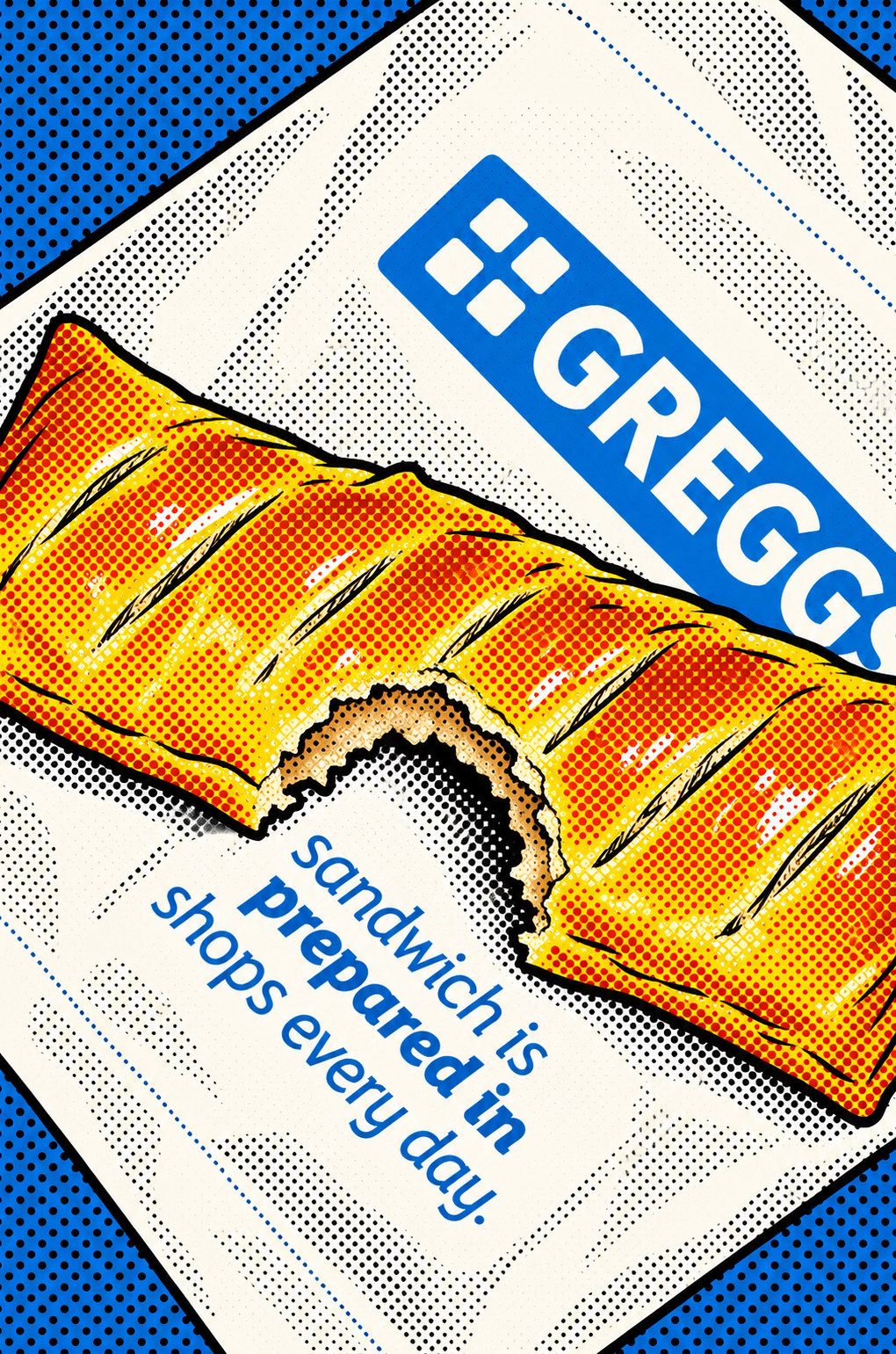
The press release promised a bar designed according to a belle époque specification. Picture Leonardo DiCaprio wearing a tuxedo, lifting a wide-brimmed glass of champagne in a GIF scraped from The Great Gatsby—and then picture him with a sausage roll in his other hand.
Online videos made by influencers emphasized the grandeur of the offering, mostly without irony. One can order a bottle of Bollinger at the Greggs champagne bar, temporarily located in the Fenwick department store in Newcastle during the Christmas period. The fizz will accompany your order of a sausage roll, vegan sausage roll, steak, chicken, cheese and onion, baked bean or festive bake, each of which comes with a trendy-sounding accompaniment such as Brussels sprout kimchi. The pastries are cut into triangles by the solitary teenage chef and are served on large, heavy blue plates, each dish inexplicably garnished with a pinch of limp cress.
The mild excitement I had before my arrival gave way to mild disappointment once I had taken my seat. The bar was in a corner of the Food Hall, opposite a coffee shop and a precarious pyramid of Lindt chocolates. It had some twenty barstools lined up along a faux marble counter, the counter being at least a foot too tall, so that you had to unfold your elbows to reach up to the eating surface like a child. Aside from the champagne, the only belle époque gesture there was a string of low-hanging lights – ornate glass fittings hung by coiled brown wire that seemed muted amid the brightness of the store.
Wizzard’s “I Wish It Could Be Christmas Every Day” was being played from a Bluetooth speaker on the working side of the bar, and before me, as I sat with my chin almost leaning on the counter, was a glass bell placed on a surprisingly dirty mat that read ‘ring for service’.
I have become something of a Greggs expert. It all started when I walked into a Primark in Newcastle and observed a group of teenagers in a state of wild excitement over a range of Greggs-branded clothing: bucket hats and bum bags, plastic clogs and basketball vests, boxer shorts with a hundred little sausage rolls on. I decided to make a podcast episode about Greggs and found out that the bakery (although Greggs hasn’t sold bread since 2013) sells some 3 million sausage rolls every week and persistently tops its rivals in public polling as Britain’s best loved high street food chain.
The following year I was asked to discuss Greggs on BBC Radio 4’s The Food Programme. I met the crew at a Greggs in Leicester Square and a well-dressed woman, whom I took to be the show’s producer, asked me what my favourite item was. None of it, I told her, if I’m honest. The woman turned out to be from Greggs’s corporate PR team. I alleviated her horrified reaction by explaining in positive terms during the interview just why Greggs has become a national institution. It taps into a deep English tradition of eating buns, pies and sausages – seasoned, I pointed out, with a little cayenne, nutmeg and mace, a once distinctly elite flavour profile (in the medieval period) that had been taken up, I said, in the anti-French mode of eighteenth-century county cooking. It also speaks to our tradition of urbanised industrial-imperial eating; the imported palm oil that serves as the fat in the pastry and the filling recalls an approach we’ve taken to food in England for 150 years. The Greggs sausage roll, I said, is the closest thing we have to a national dish today, one that—and this is essential, I pointed out— everyone can afford. The PR person looked mostly relieved.
Not long after this interview I appeared on a Channel 4 documentary about Greggs presented by Dani Dyer, where I was made to take a fat bite from a cold, almost stale jam donut in front of the cameras. Having prepared for this too, I now find I know more about Greggs than is reasonable for any one person to know.
The first Greggs VIP card was awarded to the rapper Stormzy in 2020, entitling him to a lifetime’s worth of sausage rolls and steak bakes. Another card was given to the pop musician Ed Sheeran, who, in turn, gave it to LadBaby, the YouTuber responsible for no less than five Christmas number one singles about eating sausage rolls, all of them awful.
The first ever Greggs was opened by John Gregg on Newcastle’s Gosforth High Street in 1951. In 1968 he opened the firm’s first factory. In 1972 Greggs began taking over other, less successful bakeries in Leeds and Glasgow, a process of expansion that peaked in the mid-1990s when Greggs acquired the national chain Bakers Oven.
In 2012, UK Chancellor George Osborne attempted to change the way food is taxed, but the changes were branded by the Sun newspaper as “the pasty tax,” and competing politicians were photographed eating at Greggs until Osborne backed down. The pasty tax was one of only a handful of policies in his austerity agenda that was successfully resisted.
At the time of writing, Greggs has 2,675 outlets in the UK, which is about 1,200 more than McDonald’s. In Newcastle city centre – the city with the highest Greggs concentration in the known universe – I worked out you are never more than five minutes’ walk from a branch of the bakery. Nationally, Greggs employs more than 20,000 people, it makes some £2 billion in revenue each year and it takes almost £2 of every £100 spent in the UK hospitality sector. It sells more sausage rolls than McDonald’s sells Big Macs and more coffee than Starbucks.
The first Greggs VIP card was awarded to the rapper Stormzy in 2020, entitling him to a lifetime’s worth of sausage rolls and steak bakes. Another card was given to the pop musician Ed Sheeran, who, in turn, gave it to LadBaby, the YouTuber responsible for no less than five Christmas number one singles about eating sausage rolls, all of them awful.
Experts in Greggs, such as myself, may be aware of an advert for Greggs that is less well known than their stratospheric launch of the vegan sausage roll, their controversial depiction of the baby Jesus as a sausage roll (as part of their Merry Greggsmas advent calendar), or the Christmas campaign featuring the plummy cookery writer and celebrity chef Nigella Lawson. The advert I’m talking about shows employees of Greggs going undercover at a “gourmet food festival.” The plan, we’re told, is for Greggs to pretend to be a grander-sounding company going by the prim name of Gregory and Gregory. “We’re here today to test Greggs’s new summer range on some of Britain’s most discerning palates”, a server dressed in the fake brand’s muted tones tells us. The camera cuts to shots of clinking champagne glasses and expensive-looking food stalls, some run by Michelin-starred chefs.
Of course, the discerning attendees who appear in the ad love Gregory and Gregory’s summer salads and wraps. The first person to be introduced is a man wearing a Sgt Pepper–style jacket, a flat cap and an ear piercing, who declares, unironically, that “avocado is so au fait at the moment, it [the vegan wrap] definitely pops.” “I’m not usually a vegan type of person,” another man in a checkered Ralph Lauren shirt tells us with his mouth full, “but this is really good.” An older man with a signet ring and a navy sweater draped over his shoulders waves around a pot of salad, pronouncing it to be “very well balanced.” When the server turns around the sign to show that the food is actually from Greggs, the discriminating foodies are shocked. “Greggs?!” a white man with dreadlocks sporting a waistcoat scoffs. “Dear God, you’re joking,” says another in a home counties accent.
The ad suggests, perhaps it even shows, that everything upper-class foodies eat is little more than an affectation, its ostensible quality being nothing more than a façade of pretence and expense. Being a foodie is, in a word, “posh.” Since, behold: Greggs is just as good as the food these snobs are eating – the food sold to them at rip-off prices by Michelin-starred chefs and at middle-class establishments like the River Café.
The stunt gets to the heart of Greggs’s highly successful marketing strategy. The ad suggests, perhaps it even shows, that everything upper-class foodies eat is little more than an affectation, its ostensible quality being nothing more than a façade of pretence and expense. Being a foodie is, in a word, “posh.” Since, behold: Greggs is just as good as the food these snobs are eating – the food sold to them at rip-off prices by Michelin-starred chefs and at middle-class establishments like the River Café.
And what is good food, anyway? Maybe there’s really no such thing, or at least there’s no such thing as food that’s better than what you get at Greggs. The ad helps position Greggs as a national cuisine, since it reinforces not only the idea that “gourmet” food and discerning taste are posh, but also that, in fact, there’s no such thing as “gourmet” food or discerning taste.
There are two additional ways in which Greggs speaks of our food traditions. The first, as I said in my Radio 4 interview, is its reference to the kind of post-medieval country cooking that was popular in England in the 18th century. The iconic Greggs sausage roll is faintly seasoned with spices in a manner that might have been familiar to Hannah Glasse and Elizabeth Raffald. Greggs also alludes, albeit to a very limited extent, to regional baking traditions. In London, for example, you can buy Tottenham cakes, essentially sponge cakes with pink icing. Greggs in Newcastle sells stotties, the pleasingly round flatbreads that sometimes have a hole poked in the middle and which vaguely resemble oversized English muffins. I’m told that Glasgow has a handful of local offerings, including Scotch pies and lorne sausage.
Secondly, Greggs speaks to our familiarity with industrially processed food, which – and this would be unfamiliar to Glasse and Raffald—has enabled people in Britain to regularly eat meals that were once the preserve of the wealthy. According to analysis carried out for a Channel 5 documentary, the sausage in a Greggs sausage roll is only 22 per cent pork, meaning that it legally cannot be labelled a pork sausage roll. Britain has a long history of lower-class foods being adulterated, and so this low pork content might itself be something of a long-standing tradition. The presence of modified maize starch, milk protein isolates, emulsifiers, stabilisers and regulators are all distinctly modern, industrial versions of this tradition, albeit ones that we came to accept some time ago.
A cork pops at the Greggs champagne bar in Newcastle. A woman sitting on the stool next to me receives her first course and, seeing it, remarks to the waiter – and this is a direct quote—“Oh, it’s very posh the way you cut the sausage rolls.” At a corner of the bar another woman bops her head to a Caribbean steelpan rendition of “Hark the Herald Angels Sing.” Then, after the first bite of her festive bake, delicately eaten with a knife and fork, I see her dramatically mouth the words “oh my lord!” to her dining partner, who keenly nods his agreement.
The belle époque setting is a reference to the era of Escoffier, a reference that has the same knowing quality as the Gregory and Gregory ad. In both cases we have some of the motifs of “posh” culture, but – and because we know poshness is little more than a scam—they aren’t taken entirely seriously. Like most of what Greggs sells you, it’s really all a bit of a joke. There’s a gesture toward the kind of environment one encounters at Restaurant X, yet here we are in a department store eating cheap pies.
The experience of eating the bake, which comes with its signature unctuous gravy, is not dissimilar, I can’t help thinking, to that of eating hot cat food wrapped in a claggy shell. Next to arrive is the sausage roll, which comes with an incredibly sweet “hot honey chilli sauce,” and then, shortly after, the mysterious festive bake (vegetable filling unknown) with Brussels sprout kimchi.
I order a steak bake, which comes with a small pot of wet peppercorn aioli in which it is hard to make out either pepper or garlic. The experience of eating the bake, which comes with its signature unctuous gravy, is not dissimilar, I can’t help thinking, to that of eating hot cat food wrapped in a claggy shell. Next to arrive is the sausage roll, which comes with an incredibly sweet “hot honey chilli sauce,” and then, shortly after, the mysterious festive bake (vegetable filling unknown) with Brussels sprout kimchi. To drink I have a glass of Gremillet brut champagne and, to end, at the recommendation of my friendly server, a cream éclair dessert cocktail, which is a refreshing, alcoholic chocolate milk. My total bill comes to £40.90, plus the service charge.
Food critics have the difficult task of judging meals while knowing that taste is highly subjective. And yet, as we’ve seen, taste is also deeply social. In that vein, here was a traditionally English pre-Christmas meal; all that was missing was the option of a pint of lager and a chicken balti pie.
The service bell and the coupe glasses of champagne are signs of a world turned upside down during the festive period, yet one that, by way of its contrast with the day-to-day, speaks of how the world appears when it is the right way up. Here we were, sat on stools, my fellow diners and I, cos-playing as members of the elite, except that we, the righteous sausage roll-munching classes, know what a decent plate of food really is.
For those of our countrymen who fail to personally identify with Greggs’s working-class tropes, it is these qualities that lend the sausage roll a naughty or else comical frisson. It is Nigella Lawson taking a delicate bite of a festive bake in the Greggs advert, seductively eyeing the camera and announcing that this is “the very flakiest of pastries.”
As a national pastime, eating at Greggs speaks of the ways in which English food was modernised by the peculiar experiences of urbanisation, industrialisation, empire and war. Greggs is what has emerged in the wake of our native baking traditions having been eroded and replaced by sliced white loaves and sourdough. Some of Greggs’s offer lays claim to the pre-modern past, yet it is first and foremost a product of English modernity.
Our love of Greggs – our championing of it—even, or especially, when it is ironic, expresses our ingrained sense of food as something unworthy of refinement, artistry or serious concern. Greggs is the vast, popular bedrock of a functionalist English food culture, a culture that is as often counterposed to the smug, hypocritical elitism of the new middle classes as it is comically contrasted with the tradition of bourgeois fine dining.
There is surely scope today for a renewed English cuisine, and from the point of view of our bodily and planetary health there is surely a pressing need for one. Our nation is likewise in great need of a new, common sense of pride—an emotion that, when sublimated, can too often manifest itself as a flag-waving form of hatred. Xenophobia promises a refuge from modern alienation, but it is a fundamentally malign force. By contrast, artisanal culinary endeavour and the labour of human hands can provide a joyful, uplifting alternative, crafting objects that inspire both pleasure and respect.
When food and cooking become worthy of pride they also become something akin to an artform. But in order for such an artform to become the pastime of a nation, that nation must become more equal than ours is today. It is only a society of equals “which can choose to forgo gross luxury and base utilitarianism in return for the unwearying pleasure of tasting the fulness of life”—so wrote the Victorian activist and artisan William Morris. “It is my firm belief,” Morris continued “that we shall in the end realize this society of equals, and also that when it is realized it will not endure a vicarious life by means of machinery; that it will in short be the master of its machinery and not the servant, as our age is now.”
It is not for individuals like me to write recipes for the cooks of the future. The birth of a new, democratic cuisine will be both a means and an outcome of a political movement that is serious about enriching society as a whole. It will be a means, because any movement that aims to restore the public realm will be technocratic and unpopular without cultural investment. A means, too, because any policy agenda aimed at redistribution will require an accompanying moral framework if it is to have a basis for consent. It will be an end of such a movement because there can be no proud national food culture so long as our society is as materially divided as it is now, or at least no national food culture beyond the likes of Greggs.
This essay is excerpted from The Full English: The Ways we Eat and Why, published by Verso.